

Alén Space strengthens its role in the Low-LEO layer of IRIS² programme through three strategic projects
September 17, 2026
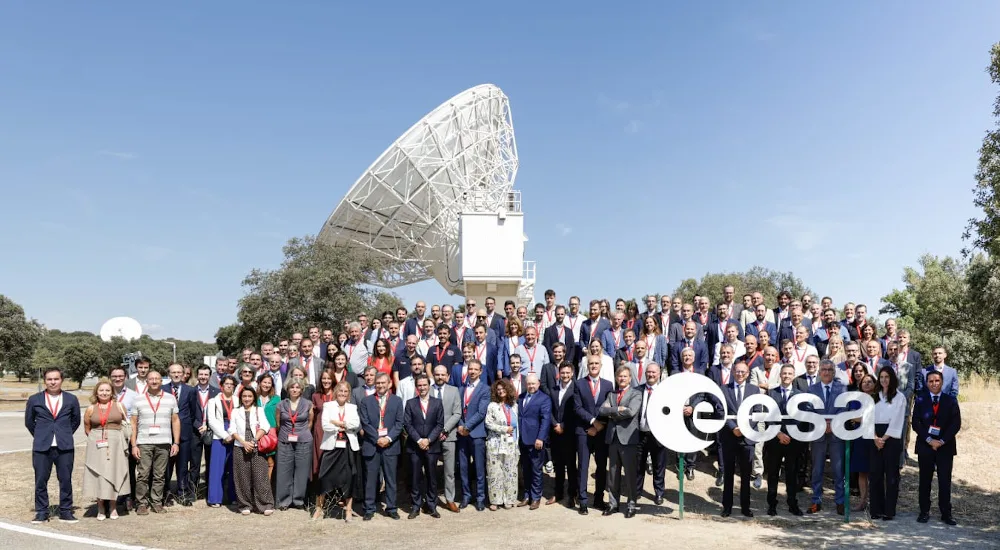
The European Space Astronomy Centre (ESAC) in Villanueva de la Cañada, Madrid, hosted today’s official kick-off event and contract signing ceremony for the Consolidation Phase of the European Space Agency’s (ESA) IRIS2 Low-LEO Pre-Operational and De-Risk Activities, within the Agency’s Programme Related to EU Secure Connectivity. Under this framework, Alén Space is contributing to three strategic projects: ARGUS, Poseidon and LYRA.
The event represents a key milestone for the European space industry, bringing together leading companies from across the sector to mark the official start of activities designed to drive the future of LEO technology and support the European IRIS² programme.
The day also served to set project roadmaps, define technical goals and formalise agreements within an initiative involving several European consortia aimed at developing pre-operational mission concepts and de-risking solutions.
Key technology and engineering for three projects
Alén Space continues to strengthen its position as a trusted technology partner in the small satellite sector by participating in three major projects within ESA’s Low-LEO Consolidation phase. Across these initiatives, the company provides engineering capabilities, specialised hardware and mission integration expertise.
In ARGUS, a pre-operational mission concept led by GMV in collaboration with Alén Space and arcsec, the project combines radio-frequency interference detection, and spectrum and space domain awareness, paving the way for future governmental services under IRIS².
ARGUS envisages a constellation of up to five 16U CubeSats equipped with spectrum awareness payloads and optical observation capabilities based on advanced star trackers. The RF payloads would support interference detection and characterization, covering both emitter geolocation and emitters in orbit. Complementing these capabilities, the optical sensors would detect and track satellites, space objects, and orbital debris, contributing to enhanced space domain awareness, the identification of emitters relevant to spectrum and interference awareness services, and the protection of the constellation itself.
The concept also relies on a federated architecture, in which data collected by the different satellites would be combined on the ground using advanced data processing and fusion techniques, enabling the generation of higher-value products for users. The architecture is also designed to accommodate additional sensors in the future, including hosted payloads on other satellites and external data sources. This would facilitate a gradual evolution toward a scalable and interoperable European space surveillance infrastructure compatible with IRIS².
As part of ARGUS, Alén Space contributes the critical link between RF awareness service concepts and their efficient implementation on agile space platforms. Under the proposed mission architecture, the company’s role would cover the design and manufacturing of up to five 16U CubeSats, as well as the development of the payload based on its software-defined radio technology. Alén Space would also contribute its Mission Control Software to support ground segment operations. The project builds on its experience in fast-paced missions and flight-proven technologies.
Alén Space and GMV also participate in Poseidon, led by OHB Italia as prime contractor, as part of a European industrial consortium focused on the development of satellite services for maritime surveillance, safety and resilience. The project integrates VDES, including AIS vessel tracking and two-way narrowband communications, together with visible and thermal observation and radio-frequency awareness.
Poseidon uses IRIS² secure connectivity as a Space Data Relay Service to support near-real-time monitoring of critical maritime use cases, such as dark vessel detection, illegal fishing (IUU), search and rescue, and offshore infrastructure protection.
Alén Space provides key on-board technology and systems engineering know-how.
In LYRA, Alén Space works as a technology partner in a consortium coordinated by SpaceLocker and also involving WiRan and Leaf Space. The project aims to define a solution to provide greater connectivity to end users operating existing or planned LEO satellites, including both governmental and commercial operators.
The LYRA concept is based on a relay payload that would act, from the perspective of user mission-control systems, as an additional space-based ground station. This approach is intended to integrate with existing contact prediction, booking and operations workflows, providing additional secure and low-latency contact opportunities beyond the visibility of terrestrial ground stations.
Within LYRA, Alén Space leads a work package focused on defining the RF architecture of the payload and confirming the interfaces and compatibility with end-user satellites. The company also supports the wider consortium in other work packages.
Building the future of Low Earth Orbit
Alén Space’s involvement in the ESA’s Low-LEO Consolidation phase highlights the company’s technical flexibility and readiness to tackle complex mission requirements in LEO.
By combining specialised hardware, mission software and end-to-end engineering services, Alén Space continues to work closely with leading industry partners to support the development of advanced space solutions for Europe.
“Participating in these three projects is an important opportunity to contribute our experience to initiatives closely aligned with Europe’s future space infrastructure,” said Guillermo Lamelas, CEO of Alén Space. “Poseidon, ARGUS and LYRA address different mission needs, but they share a common goal: advancing reliable, resilient and scalable capabilities for Low Earth Orbit.”
“Europe’s connectivity needs are evolving, and so must the space infrastructure that supports them. Through Low-LEO, ESA is exploring new capabilities and new ways of meeting those needs, helping to ensure that IRIS² can evolve into an adaptable, resilient, and future-ready systemand future-ready system. This is an important step towards strengthening Europe’s secure connectivity for the years ahead, and we look forward to working hand-in-hand with the European Commission and European industry to turn this ambition into concrete capabilities and deliver the secure connectivity Europe will need for the future,” said Laurent Jaffart, Director of ESA’s Resilience, Navigation and Connectivity.
About ESA Programme Related to EU Secure Connectivity
Under the overall responsibility of the European Commission, IRIS² is a bold endeavour to build a space-based secure and resilient connectivity network that elevates Europe’s strategic autonomy and competitiveness, where and when it matters most. ESA acts on behalf of the European Commission as the qualification and validation authority for the governmental infrastructure of the Union Secure Connectivity Programme. It manages development and validation contracts supporting the initial space and ground segments, verifies end-to-end system, service, and security performance against EC requirements, and coordinates these activities with ESA’s own programme.
Within this programme, the IRIS² Low-LEO Pre-Operational and De-Risk Activities components provide a rapid and recurrent mechanism for validating potential new governmental services and associated mission concepts in orbit up to a pre-operational level, subject to successful maturation and later programme level decisions of integration into the operational EU IRIS² baseline.
Ultimately, these activities aim at contributing to the continued evolution and enhancement of IRIS2 services and capabilities, supporting Europe’s long-term leadership in space in an ever-changing world.